
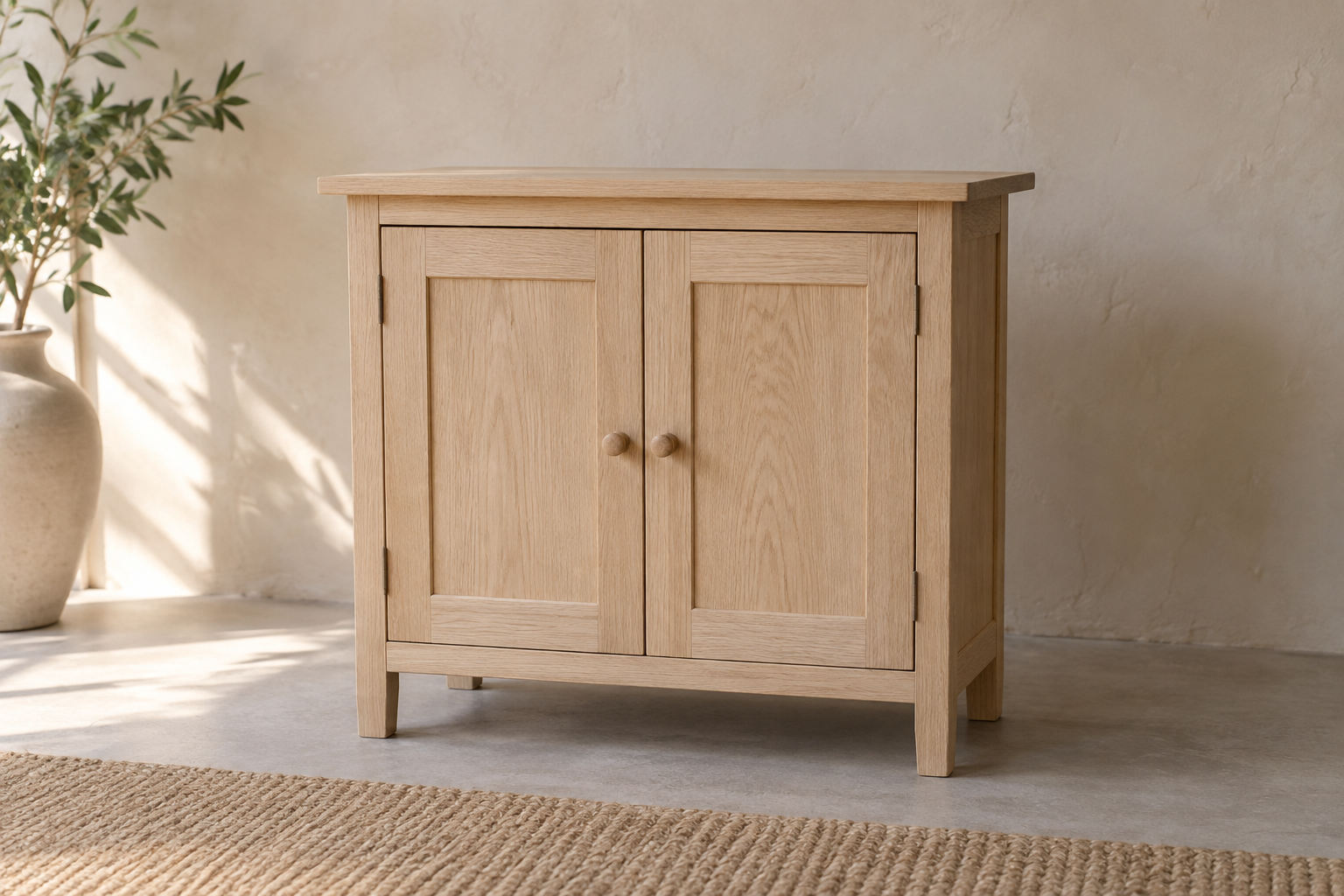
A bookcase starts with the things it must hold. Measure the tallest books, the deepest binders and the available wall space. Then allow for the side thickness, shelves and back. The outside width is not the shelf length.
A compact example
This layout uses 18 mm plywood for a 600 mm wide, 900 mm high case. The sides run full height; top, bottom and two fixed shelves fit between them. A surface-mounted 6 mm plywood back adds to the case depth.
| Part | Quantity | Finished size |
|---|---|---|
| Sides | 2 | 900 × 250 × 18 mm |
| Top, bottom and shelves | 4 | 564 × 250 × 18 mm |
| Back | 1 | 900 × 600 × 6 mm |
The shelf calculation is 600 − 2 × 18 = 564 mm. Overall depth is 256 mm, roughly 10 1/16 in. Measure your plywood: if it is thinner, recalculate the crosspieces before cutting. Edge lipping also changes finished depth.
Make the openings useful
With the bottom flush at the base and the top flush at the upper edge, the vertical space between them is 864 mm. Two 18 mm shelves leave 828 mm divided among three openings. Equal openings are 276 mm high, but a tall lower compartment and two smaller upper ones may suit your books better.
Mark all shelf positions on both sides from the same bottom reference. Clamp the sides together for matching layout. Use straight cuts and square ends; screws cannot correct a trapezoidal shelf.
Assemble and secure
For a straightforward plywood case, predrilled screws through the sides can secure the fixed crosspieces. Choose fasteners and pilot holes for the plywood you have, keep them centered in its edges, and test the connection on an offcut. Do not use a generic screw count as proof of shelf capacity.
Dry-assemble, compare diagonals, then attach the back while the case is square. A properly attached back helps resist racking. Secure the finished case to suitable wall structure with an anti-tip system appropriate to the wall and furniture. A low bookcase can still tip when climbed.
Load shelves progressively and watch for deflection. Shelf stiffness depends on span, material, thickness and edge reinforcement; this example has no tested load rating. If you want longer shelves, redesign their support instead of simply widening every part.


Comments
Post a Comment