An independent woodworking journalMake something worth keeping.
Good wood.
Useful knowledge.
A little patience.
The Wood Journal

Why Stainable Wood Filler Doesn't Match and What to Test

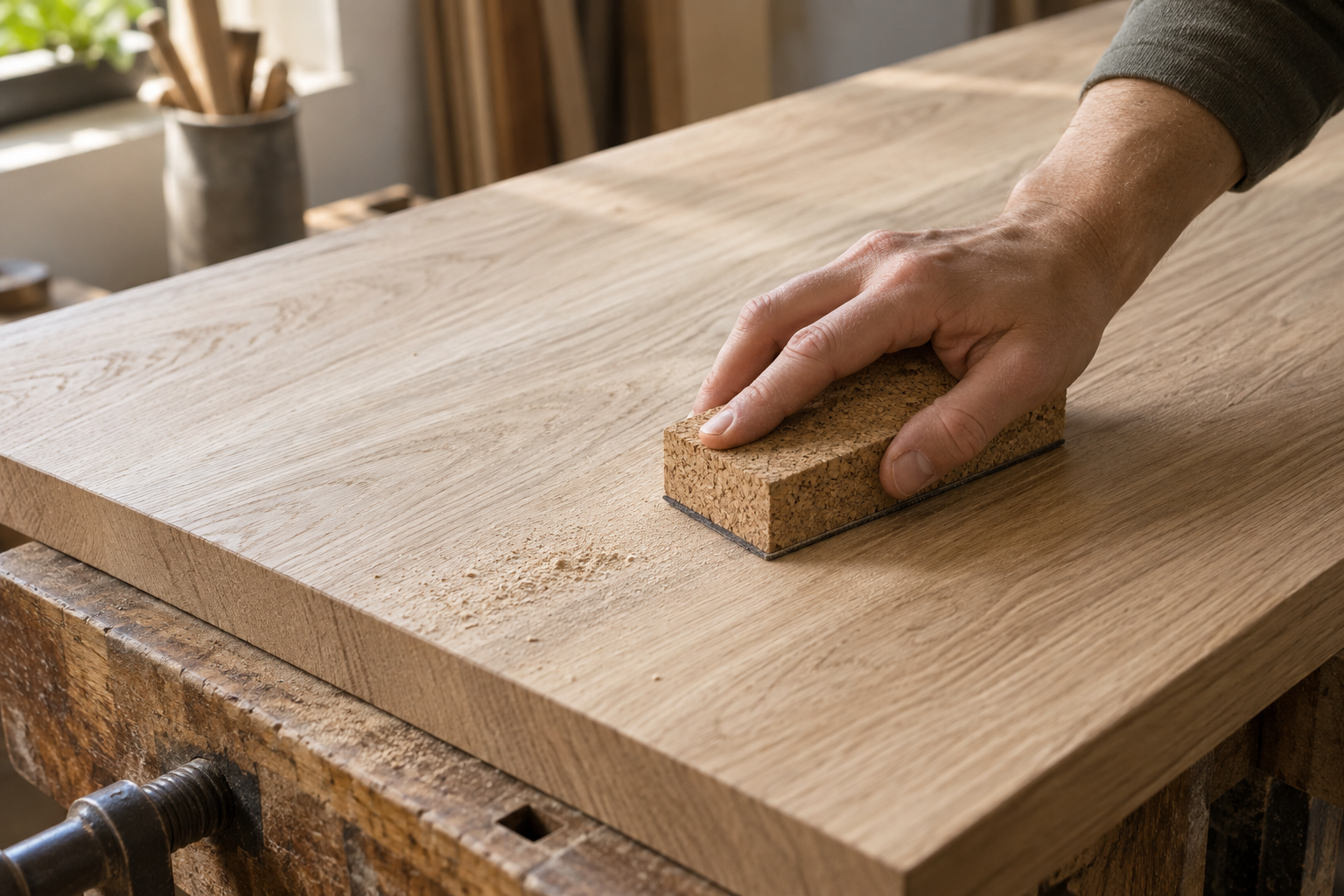
A flat sanding block preparing a wood surface
Prepare and test a filled sample before finishing the visible surface.

“Stainable” means a filler can take some color. It does not mean it will absorb the same amount as the surrounding wood or reproduce its grain. A repair can match when dry and turn conspicuous after stain or clear finish.

Match the repair to the defect

DefectFirst questionPossible approach
Small nail holeIs it purely cosmetic?Compatible filler or a color-matched finishing repair
Large missing cornerDoes it carry load or receive fasteners?Fitted wood repair or replacement part
Moving crackWhy is it opening?Correct the movement or construction problem first
Dark gap at a jointIs the joint sound and properly fitted?Repair the joint before disguising the gap

Filler is not a substitute for sound joinery. A product intended for shallow cosmetic defects should not be assumed to rebuild a stressed chair joint.

Test a real filled hole

Make a shallow defect in an offcut of the same wood. Apply the filler at approximately the same depth as the repair and let it dry as directed. Level it without dishing the surrounding surface, then run the complete stain-and-topcoat sequence over it.

A smear on the surface is a poor test because it dries and absorbs differently from a packed hole. Include a clean, unfilled area beside the sample so you can compare the actual contrast.

Watch for the halo

Spreading filler across a broad area can leave residue in the surrounding pores. Under stain, that residue may show as a pale halo much wider than the original defect. Apply it as locally as practical and remove surrounding residue according to the product instructions before coloring the wood.

If the repair is too light after finishing, a compatible touch-up system may offer better control than another coat over the whole board. If it is too dark, adding more stain will not make it lighter. For a prominent visible defect, a grain-matched wood patch can be more convincing than a perfectly smooth blob with no grain.

Keep the repair sample with the finishing sample. Its job is to answer one practical question: will this repair remain acceptable after the entire finish is on, in the light where the piece will be used?

Related workshop guides

Owen Mercer
Tools & workshop practice

Owen Mercer

Workshop notes on hand tools, joinery, jigs and the small habits that make a project easier.

Comments

Popular posts from this blog

Lumber Grades At A Glance

Illustrative AI-generated image. Domestic hardwood lumber found at sawmills meets different quality levels or grades as specified by the National Hardwood Lumber Association (NHLA). The basis for this wood grading is the number and size of defect-free clear cuttings in a board, as summarized below, Thickness is not a consideration, though with some species worm holes, gum pockets, and stain are acceptable. FAS (First & Seconds) lumber grade. This premium grade represents the finest lumber yield in a log. Generally, the minimum size board is 6" wide by 8' long which yields a minimum of 83 1/3% clear cuttings on its poorest face. F1F (FAS One Face) lumber grade. The best face grades as clear FAS; the worst, as #1 common, containing some knots. Selects lumber grade. Close to a FAS board. A Select board must be a minimum of 4" wide and 6' long and yield a minimum of 83 1/3% clear cuttings, but only on one face with #1 common on the worst face. #...

How to buy Sawmill Hardwood and Save (Part 1)

Illustrative AI-generated image. When you visit a home center to purchase hardwood lumber, more than likely you'll encounter limited quantities, limited species, and through-the-roof pricing. In some cases, you're paying for that shiny cellophane wrapper. Before you sell your tools and steer toward a different hobby, you need to check out the benefits of shopping at a lumber sawmill. While some mills service only the commercial building industry. make pallets, or ship woods overseas, many gladly sell to the local woodworker. Here is where you'll find great variety and huge savings. If the special lingo and ways in which sawmills sell hardwood have kept you at bay, let us help you shop like a pro. First things first: finding a sawmill. While your local yellow pages will yield results when you look under "Sawmills” or “Lumber-Retail," members of 10 cal woodworking clubs, woodworking friends, or woodworking specialty stores may serve as better sources for locati...

4-Step Antique Finish

Create a fool-the-eye timeworn look. Some projects, like wine server for your wood cabinet, are not unlike a pair of blue jeans, Both look better after a few years of regular use. To create that well-worn look wood finish, I have come up with a finishing schedule that can add a century's worth of character in less time than it would take to stonewash a new pair of Levis. At first glance, this four-step finish might appear demanding, bur keep reading. As you'll soon learn, this special finish amounts to little more than a combination of a few basic techniques you've probably used before. The “pickling" and - “highlighting” I use aren't much different than whitewashing a fence. Simply brush on the color and then wipe some off until it looks good to you. And after each step you'll apply a quick-drying seal coat to save your work. Besides providing an additional decorative element to your work, antiquing has some practical advantages. Adding color to t...

It starts with
a piece of wood.

Unfinished Wood is a collection of practical ideas for the workshop: choosing your materials, solving small problems, and bringing out the character in what you make.

The journal voices

Owen Mercer
Tools & workshop practice

Owen Mercer

Workshop notes on hand tools, joinery, jigs and the small habits that make a project easier.

Ben Harlow
Wood & materials

Ben Harlow

Practical guides to choosing lumber, understanding grain and planning for wood movement.

Daniel Reed
Surface & finish

Daniel Reed

Notes on sanding, test samples, color and finishes that let the character of the wood show through.

Search This Blog