
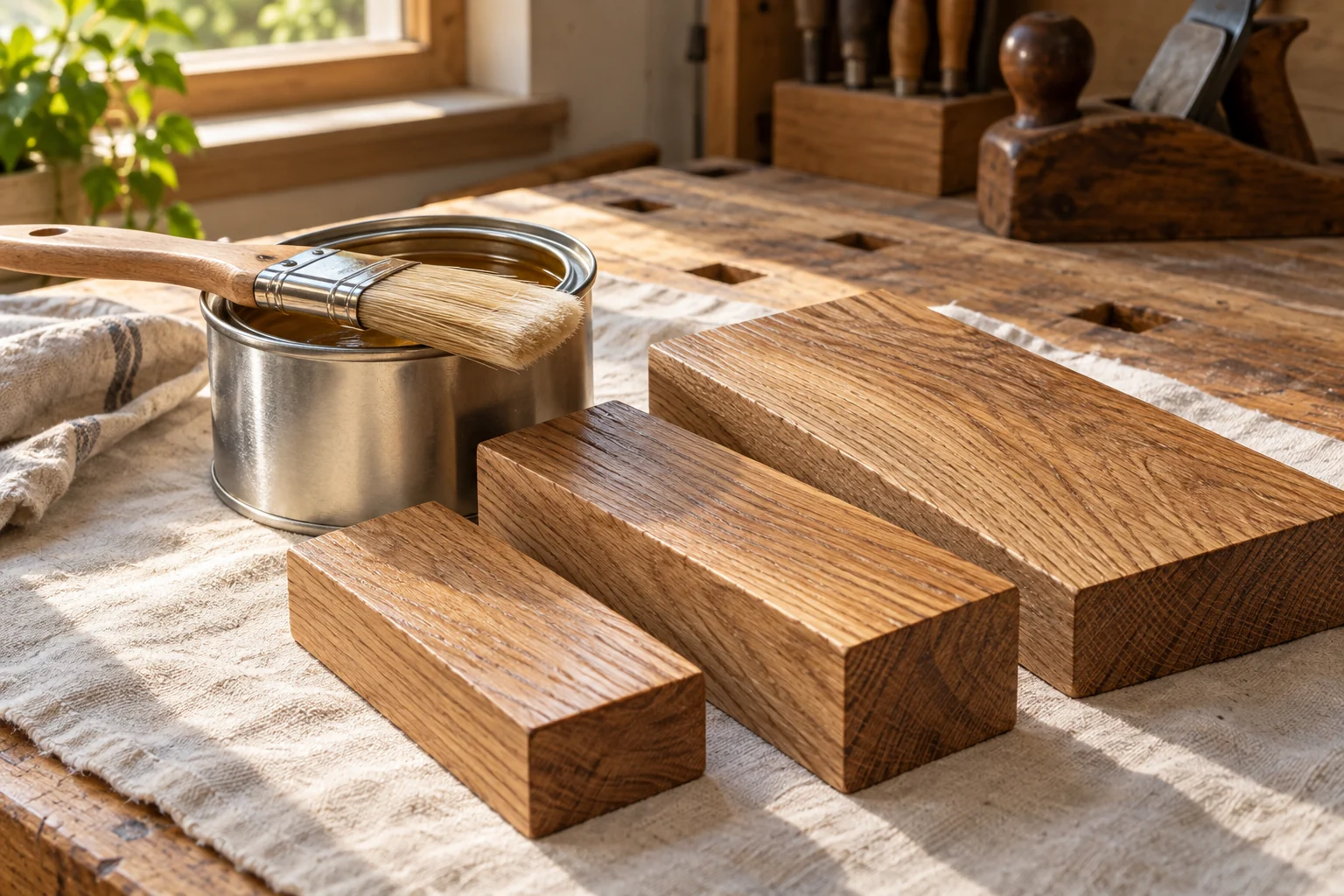
Estimate wood finish from the surfaces you will actually coat, the number of coats and the coverage stated for that product. A tabletop's length times width gives only one face. Legs, edges, undersides and shelves can add enough area to change the size of the container you need.
Use one unit system throughout the estimate. The calculator accepts square meters and coverage in square meters per liter per coat. If your label uses square feet per quart, calculate entirely in those units or convert both the area and the container unit before entering numbers. A square-foot coverage number entered as square meters will produce a badly undersized purchase.
Count the exposed surfaces
For a rectangular part with length L, width W and thickness T, the area of all six faces is 2LW + 2LT + 2WT. That includes the two broad faces and four edges. If you will not coat a particular face, subtract its area. For irregular parts, divide the surface into simple rectangles or measure a paper pattern; an estimate with documented assumptions is more useful than an unexplained precise number.
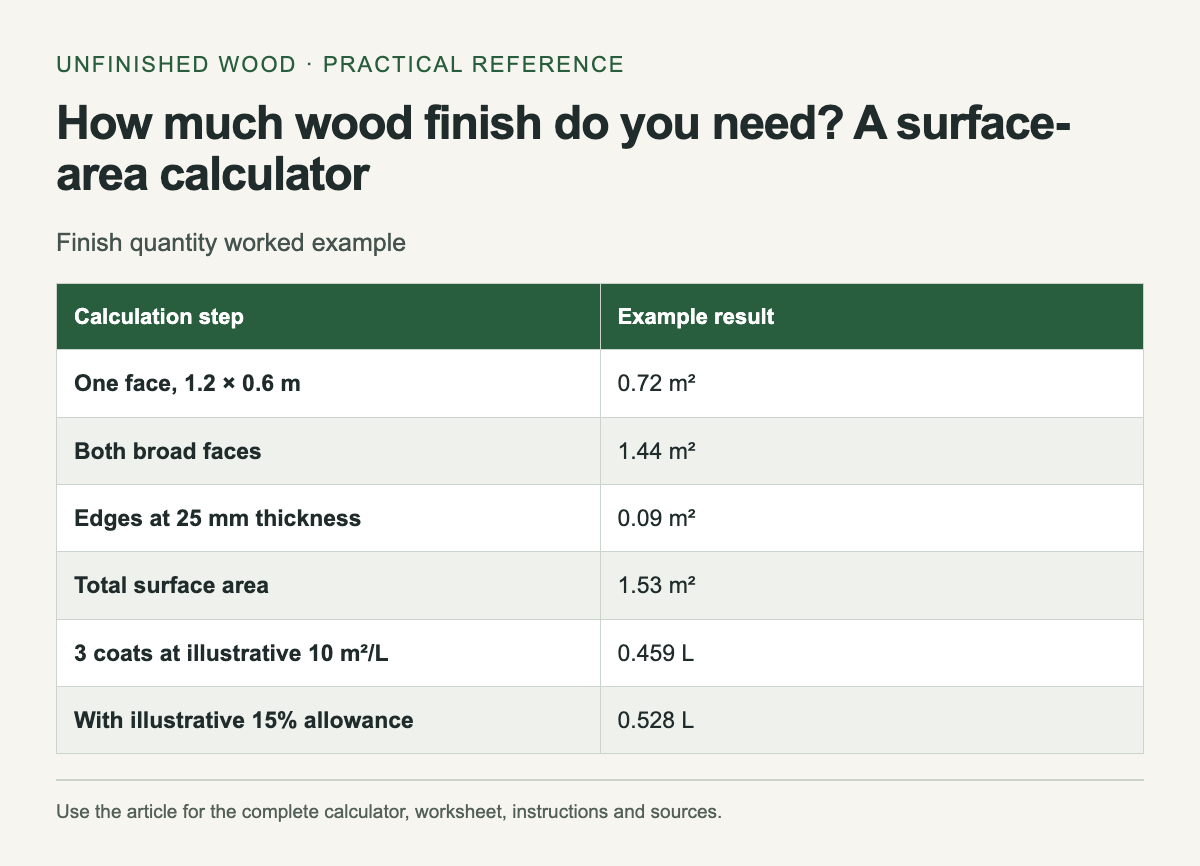
A sample panel measuring 1.2 × 0.6 × 0.025 m has 1.44 m² across both broad faces and 0.09 m² around the edges, for 1.53 m² total. Four such panels would have 6.12 m² if every face and edge receives finish. Joint faces that will be glued need separate treatment in your finishing plan.
Use the coverage of your exact product
Manufacturers publish different coverage ranges for different finishes. General Finishes' comparison chart includes several different ranges, even within clear topcoats. Read the instructions for the product, application method and coat you intend to use. Do not carry a familiar varnish number over to an oil, stain or spray system.
When the label provides a range, using its lower area figure gives a more conservative volume estimate. Rough or absorbent surfaces and application losses may change actual use. The calculator's allowance is a planning choice, not a guarantee of coverage, and it does not change the manufacturer's required coat thickness.
Calculate liters before choosing a tin
The formula is area × coats ÷ coverage × (1 + allowance ÷ 100). For 1.53 m², three coats, an illustrative coverage of 10 m²/L and a 15% allowance, the result is 0.528 L. Those coverage and allowance figures are invented planning inputs for the arithmetic example, not a recommendation for a particular finish.
Round up to a container combination that covers the estimate. Check whether you already have usable material from the same product and color. Include sample boards in the project area if you plan several tests. Keep some product details with the furniture: brand, product name, sheen, color and application dates.
Check the schedule as well as the quantity
Enough finish in the workshop does not make the project ready for service. Recoat intervals and full cure are separate instructions. Check ventilation, application temperature and cleanup or rag-disposal requirements on the label before starting. For finishes that warn about spontaneous combustion of contaminated rags, follow the stated handling and disposal procedure immediately.
After the first sample or coat, compare consumption with your estimate. If the project is using substantially more, review area, application method and losses before buying the next container. Save the corrected calculation for the next piece rather than treating the first estimate as a fixed rule.
Use a repeatable finish sample to record the actual coating schedule before estimating the quantity for the full piece.
| Calculation step | Example result |
|---|---|
| One face, 1.2 × 0.6 m | 0.72 m² |
| Both broad faces | 1.44 m² |
| Edges at 25 mm thickness | 0.09 m² |
| Total surface area | 1.53 m² |
| 3 coats at illustrative 10 m²/L | 0.459 L |
| With illustrative 15% allowance | 0.528 L |
Calculate your dimensions
Values stay in this page. The worked example also works without JavaScript.
Related workshop guides
- Make a finish sample you can actually repeat
- Water-based topcoat over oil stain: a compatibility checklist


Comments
Post a Comment